
· 7 min read · worthmydegree.com
For counselors: the money conversation, in the time you actually have
You are asked, several times a week, to be a financial advisor. Without the license, without the training, and without the hour per family it would honestly take.
So the question is not whether you can do this arithmetic for every student on your caseload. You cannot, and nobody should ask you to. The question is what you can hand them that does it for them, that works when you are not in the room, and that you can trust enough to put your name near.
What changed underneath your students in 2026
Worth knowing even if you never open the tool, because families will not have heard it and it changes advice you may have given last year in good faith.
Parent PLUS has a ceiling now. For loans first disbursed from July 1, 2026, it is capped at $20,000 a year and $65,000 in total per student, across both parents combined. It used to be limited only by cost of attendance minus aid, which in practice meant no ceiling at all. "We will borrow the gap" was a real plan and now it may not be.
The aggregate is the half that bites. Four years at the annual maximum would be $80,000, so the $65,000 total is what actually binds, and it binds in the year a family has the least room to move. Borrow the maximum for three years and about $5,000 of PLUS remains for senior year.
A dependent undergraduate's whole federal ceiling is therefore $27,000 of their own Direct loans over four years, plus $65,000 of Parent PLUS. About $92,000 all in. Anything a school costs above that is private borrowing: credit-checked, usually co-signed, and carrying none of the income-driven repayment or forgiveness that federal loans do.
Repayment changed too. For a 2026 start the income-driven plan is the Repayment Assistance Plan, which sizes the payment from income rather than from the balance and writes off the remainder after 30 years. And since January 1, 2026 a balance written off at the end of an income-driven plan is taxed as ordinary income in the year it is discharged. Forgiveness is a bill deferred rather than a bill canceled, which is worth saying out loud to any family treating it as a plan.
The three conversations it makes shorter
The student who has already decided
They have one school in mind and have not priced it. You do not want to talk them out of it; you want the number in front of them while the decision is still open.
Type the school, pick the major, and the tool builds the loan from what graduates of that specific school who borrowed actually left with. No forms, no aid letter needed. Then the verdict box answers in a sentence and names the loan amount at which the answer flips. That ceiling is the number a student can act on, and it lands differently from "it depends".
The student who has ruled college out on price
This is the one where the tool earns its place, because a sticker price is a terrible reason to rule anything out and it is the only number most families see.
Under More tools, Find schools that fit a budget runs the question backwards: pick a field of study and a price ceiling and it returns every college in the data that teaches it inside that budget, priced in-state or out-of-state for where the student actually lives. There are 5,035 schools with published costs in there, and the point of the feature is the ones a family has never heard of.
Two things to know before you point a student at it. It sorts by cost and nothing else, and it never claims a pricier school leads to higher pay. And the prices are sticker before aid, so a school that looks out of reach may not be, which is what the net price calculator link is for.
The student who is not going to a four-year school
BLS says 430 of the 825 occupations in the data are entered with a high school diploma or less. The tool charges those paths no tuition, no loan and no given-up years, while the pay comparison stays exactly as it was.
The best-paid of those 430 is a nuclear power reactor operator, at a median of $122,890. Elevator installers are close behind at $109,910. Those are national medians for people already doing the work rather than promises, but they are the kind of thing a student has never been shown, and the tool will put either of them next to a four-year degree without editorialising.
There are another 48 occupations entered with an associate's degree, costed over two years rather than four, and the community-college path prices a transfer or the whole degree locally.
Put any of those in one side of Compare Two Scenarios and a four-year degree in the other, and the student sees two full paths side by side, same arithmetic both sides, no thumb on the scale. That comparison is judgment-free in a way a conversation with an adult sometimes cannot be, which is occasionally the whole value.
What you can hand them
Everything below needs no account, no email and no setup.
- It works on a phone, so a student can explore before a meeting or after one. Nothing to install, nothing to prep.
- Nothing is attached to a name. No login, no email, no account.
- The PDF is the part that goes home. One page, sourced, with the charts and the figures. The conversation continues at a kitchen table you are not sitting at, which is where most of these decisions actually get made.
- A share link reopens the exact scenario, so a student can send you what they were looking at rather than describing it.
What to say about the numbers
Three caveats worth repeating to a student, because the tool states them and a student will skim past them.
Every salary assumes they work in the field they picked. Nationally that holds for about six in ten graduates. The Federal Reserve Bank of New York puts underemployment at 39% overall, ranging from 13% in nursing to 66% in criminal justice. In Major mode those graduates are counted in the average, which makes it the more cautious basis; in Career mode they are not, because that mode reports what people already doing the job earn.
The comparison is against a high school graduate who started working at eighteen, using real median pay for that group, currently $51,688 a year. It is a demanding test rather than a flattering one, which is the point.
The school affects the cost side only. No salary anywhere in the tool comes from the institution. It will not tell a student that a pricier school pays better, because the data underneath it does not say that.
What it will not do
It does not rank schools, it does not recommend, and it is an educational estimate rather than financial advice. Every figure is a national median or a published federal number, so it will not match one family exactly. That is the argument for the Get Your Real Numbers step, which links to the school's own net price calculator and the federal Student Aid Estimator and replaces the averages with the family's own figures.
It also cannot tell you which student in front of you is about to make a decision for the wrong reason. That part is still yours.
Run it before you recommend it
Every figure above comes from public federal data, and the Methodology section at the bottom of the calculator traces each one to its source. Take ten minutes with a school you know well and a major you have advised on a hundred times, and see whether the number it produces matches the one in your head.
If it does, you have something to hand out. If it does not, you have learned something more useful than an article could tell you, and I would genuinely like to hear which way it went.
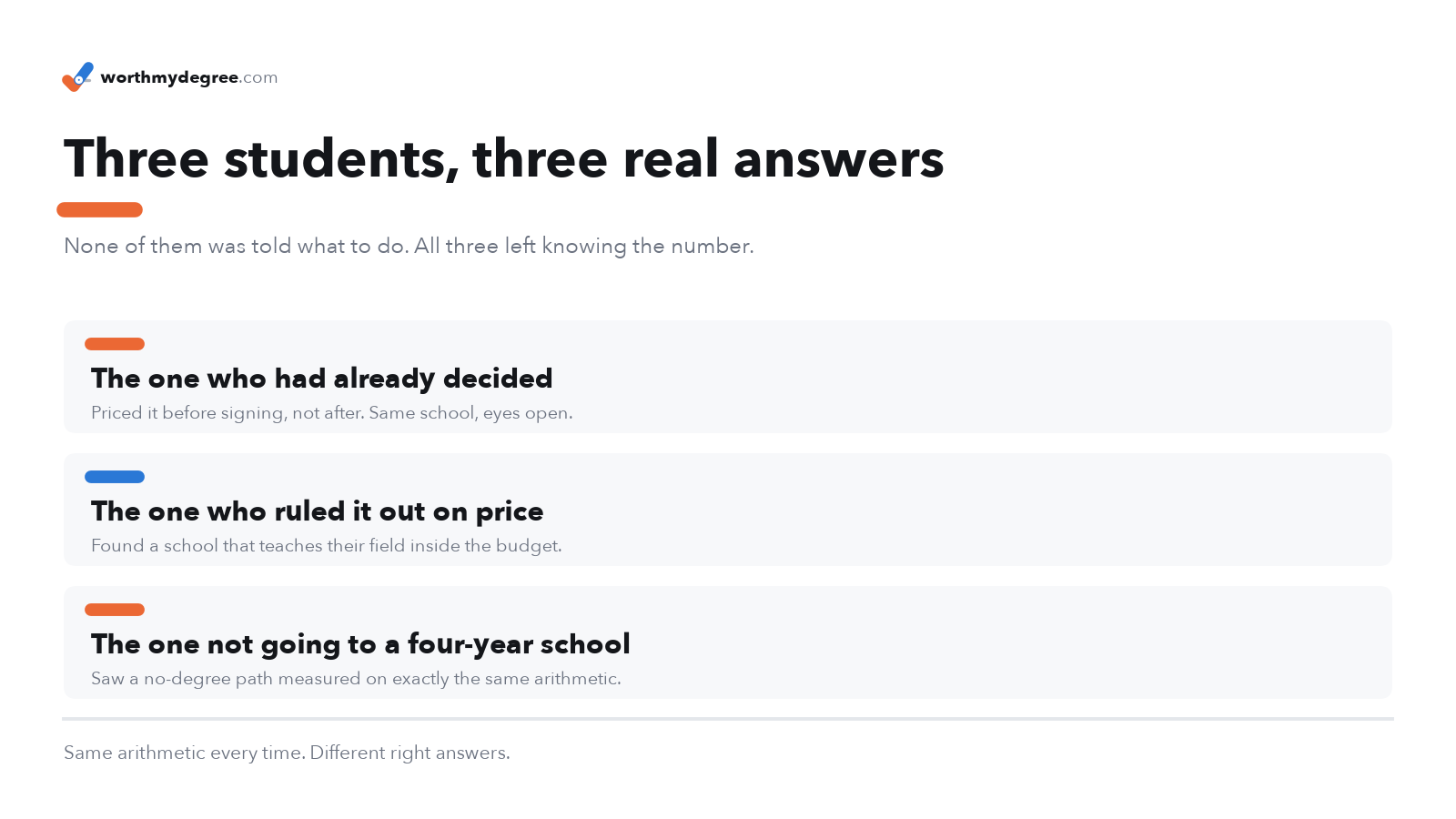
None of those three was told what to do. That is the outcome worth wanting, and it is the only one a calculator can honestly deliver.