
· 12 min read · worthmydegree.com
What refinancing a federal loan buys, and what it sells
The question almost always arrives as a rate question. Someone is carrying federal debt at 8 or 9 percent, a refinancing company offers 6, and the difference over ten years is real money. Nothing about that framing is wrong. It is just the half of the decision that is easy to see.
Dollar amounts on this page are rounded, and they come from the same model that runs the repayment comparison rather than from any lender.
The federal system has no answer to a high rate
The first thing worth knowing is that there is no federal version of refinancing. Loans can be consolidated, and consolidation is often described as though it were the same thing, but the interest rate on a Direct Consolidation Loan is set by a formula rather than by shopping. For applications received on or after July 1, 2013, federal regulation puts it at the weighted average of the rates being consolidated, rounded to the nearest higher one-eighth of one percent.
Read that sentence twice, because the direction matters. The average is weighted, so consolidating a 9 percent loan with a 5 percent loan lands between them rather than at the lower one. And the rounding goes up. Consolidation can hold a rate steady or nudge it higher, and it is not capable of lowering one.
So a borrower who wants a smaller rate has exactly one place to get it, and that place is outside the federal system. This is why the decision cannot be made on the rate alone: the rate and the protections are not two separate questions that happen to arrive together. They are the same question.
What the trade looks like in numbers
Take $50,000 of federal debt at 8.5 percent, and a refinancing offer of 6 percent over ten years. The federal column below is the Repayment Assistance Plan, which is the income-driven plan available to loans made from July 1, 2026. It also assumes the debt is Direct loans. Older FFEL and Perkins loans cannot use that plan at all, and the only way in is to consolidate them, which under the 2026 rules carries costs of its own. What consolidating does to the plans you have left covers those separately.
That 8.5 percent is deliberately high for a federal loan. Recent undergraduate Direct borrowing has been nearer 6.5 percent, and 8.5 is closer to what graduate PLUS costs. Nobody refinances a cheap loan, so the rate worth modeling here is the one that makes somebody ask the question in the first place. At 6.5 percent every verdict below points the same way and the gaps are narrower.
The ten-year term is an assumption as well, and it is the one setting the $555. This site models a private loan over ten years because that is the common length, not because any rule requires it. A longer term lowers the monthly figure and raises the total, and a shorter one does the opposite, which is why a real offer is worth comparing on both numbers rather than on the payment alone.
| Your income | Federal, monthly | Federal, total | Refinanced, monthly | Refinanced, total |
|---|---|---|---|---|
| $30,000 | $50 | $65,000 | $555 | $67,000 |
| $50,000 | $165 | $106,000 | $555 | $67,000 |
| $80,000 | $465 | $76,000 | $555 | $67,000 |
Two columns move with income and two do not, and that is the whole picture in one table. A refinanced loan asks $555 a month whether the borrower earns $30,000 or $80,000. The federal payment at $30,000 is $50.
The two total columns need a caution the monthly ones do not. They add up every payment without regard to when it is made, and the two paths do not run for the same length of time: the refinanced loan is gone in ten years, while the federal one can run to thirty. The $30,000 row is where that matters most. Those two totals look close to level and they are not, because paying $50 a month for thirty years is a far lighter thing than paying $555 a month for ten, and money handed over decades from now is worth less than money handed over next month. Read the total columns for their direction, and not for the size of the gap between them.
The column that moves, and the column that does not
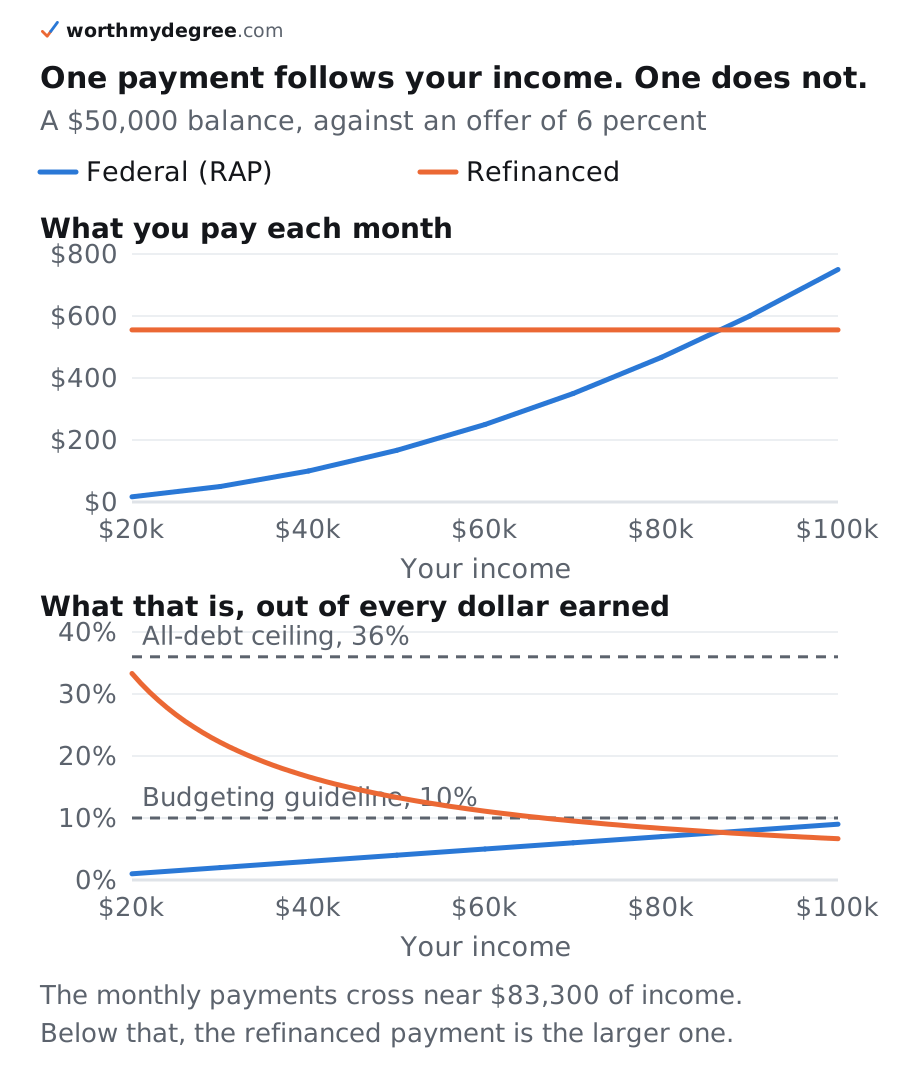
The table above gives three incomes. The picture gives the shape between them, and the shape is the argument: one line is a function of income and the other is a flat rate that does not know what the borrower earns.
Two different crossings live on this page, and the first of them turns out to be two. Start with total cost. Below about $30,000 of income the federal path costs less. Between there and about $95,000 the refinance costs less. Above $95,000 the federal path costs less again.
That top end surprises people, and it is worth understanding rather than waving away. Somebody earning six figures on an income-driven plan is paying ten percent of a large income, which clears this balance in a couple of years and pays very little interest along the way. A ten-year refinance pays a decade of it. The federal plan that looks expensive in the middle of the income range is the cheaper one at the top, for the same reason it was cheaper at the bottom: it is not on the ten-year clock.
By how much, at any of those incomes, is the question those two columns cannot answer, for the reason just given.
The monthly payments cross once, near $83,300. Below that income the refinanced payment is the larger of the two, and above it the smaller.
Put the two together and there is one narrow band, roughly $83,300 to $95,000, where a refinance is both smaller every month and cheaper in total. That is a real place to be and worth saying plainly rather than burying. Outside it you are trading one against the other: a smaller payment for a larger total, or the reverse.
Look at what the monthly column is doing underneath that recommendation. At a $50,000 income the refinanced payment is about an eighth of gross pay, against roughly 4 percent for the federal plan. At $30,000 it is more than a fifth of everything earned, against 2 percent. The model is at its most enthusiastic about refinancing for exactly the borrowers who would struggle most to make the payment.
Both numbers are true. They answer different questions. The total answers what this costs if the next ten years go the way the last one did, and the monthly answers whether the next ten years are survivable if they do not.
Why the middle row costs the most
The federal total column is not a straight line, and the shape is worth understanding rather than reading as an error. It runs $65,000 at a $30,000 income, then $106,000 at $50,000, then back down to $76,000 at $80,000. The most expensive place to be is the middle.
Low earners reach forgiveness, so a portion of the balance is written off and never paid. High earners clear the loan quickly and pay little interest. Borrowers in the middle do neither. They pay for twenty or thirty years, at a payment large enough to keep the balance moving but small enough that interest keeps pace for a long time, and they arrive at the end owing nothing and having paid the most. Nobody designs a plan to produce that result and every income-driven plan does.
What 2026 did to the other side of the trade
There is a reason this question feels different than it did a few years ago, and it is not that private lenders got better.
At a $35,000 income on the same $50,000 balance, the older IBR plan forgives nearly $89,000 over its term. The Repayment Assistance Plan forgives about $14,000. The write-off a borrower is protecting when they keep their loans federal is more than six times smaller than it was under the plan it replaced, and the term it takes to get there is thirty years instead of twenty.
The honest way to put that is uncomfortable. The case for refinancing improved in 2026, and it improved because the federal safety net shrank rather than because anything on the private side got stronger.
What this calculator cannot see
Everything above rests on three assumptions. That the income continues, roughly as the data says it does for people in this situation, every year and without interruption. That the federal protections are never needed. And that the offer is real, fixed for its whole term, and still on the table when the paperwork is signed.
The model cannot check any of the three. It has no way to represent a degree that does not finish, an illness, a layoff, or a year spent caring for somebody, so every figure on this page is what the trade looks like when nothing goes wrong. A reader can check all three, and that is the half of this decision that does not live in a calculator.
That matters more here than on any other page of this site, because the things a refinance gives up are worth precisely the amount of variance the model leaves out. Naming them is honest. Putting a dollar figure on them would not be, because pricing insurance requires knowing how likely the bad year is, and nobody knows that about one household.
What moves to the private side, in the direction it moves:
- A payment that no longer follows income. The federal payment falls when earnings fall. A refinanced payment is the same in a bad year as in a good one.
- Forgiveness. Whatever remains at the end of an income-driven term is written off. Private loans run until they are paid.
- Deferment and forbearance. Federal loans carry statutory grounds for pausing payments. Private lenders may offer hardship programs, and they set their own terms and can change them.
- Discharge on death or permanent disability. Federal loans are canceled. Private contracts vary, and the estate or a cosigner may be liable.
- Public Service Loan Forgiveness. Refinancing ends eligibility outright. There is no partial version of this one.
- Whatever relief a future Congress provides. The interest-free pause that ran from 2020 was not in anybody's spreadsheet in 2019.
Most of that list exists for people who are not earning: somebody whose degree does not finish, who becomes ill or injured, or who simply earns less than they expected to. That is what makes timing part of the decision rather than a detail of it. Those protections are worth the most in the years right after leaving school, which is also when the balance is at its largest and a refinancing offer is at its most tempting.
Every item on that list moves one way. A private loan cannot be converted back into a federal one, at any price, for any reason.
Two questions for a lender, and one for a servicer
Asking is not the decision. Getting a quote costs nothing and it is the only way to find out what is actually on offer, which is worth knowing before comparing anything. Signing is the decision, and signing is the part that cannot be undone.
Before comparing an offer to the table above, three facts are worth having in hand, and none of them is on this page.
Ask the lender whether the rate is fixed or variable. A variable rate that starts below a federal one can end above it, and the comparison above assumes a fixed rate for ten years. Ask also what happens if a payment is missed, and what hardship options exist in writing rather than in a brochure.
Ask the servicer how many qualifying payments have already been made. Those payments carry toward forgiveness, and refinancing discards them. For somebody several years into repayment, that count is often the largest number in the entire decision and it does not appear in any rate quote.
Run it on your own balance
The repayment comparison is free, needs no login, and asks for nothing that identifies you. Put in what you owe, what you earn and what rate you are actually paying, and it will show every federal plan side by side. Enter a balance in the private section to see what the same money looks like once it stops being federal.
The table above uses one balance and one offer. Yours will be different, and the income where the arithmetic turns moves with both.
This is not financial advice. Everything here is an educational estimate produced by a model, using national data and a single set of assumptions about rates, income growth and taxes. Your own balance, interest rate, family size and state will move these numbers, sometimes by a lot. Nothing on this page is a recommendation to refinance or to avoid refinancing.
A refinance cannot be undone. Before signing one, talk to somebody who can see your actual account. A nonprofit student loan counselor will go through the options with you at no cost, and is not paid by anyone who benefits from the answer.