
· 9 min read · worthmydegree.com
When a scholarship does not lower your bill
A student wins a $4,000 scholarship from a local foundation. The family sends the award letter to the college, and the bill does not move a single dollar.
The system is working exactly as written. A federal rule requires the college to count that outside money. Once the college counts it, something else in the package has to give. Which line gives is the college's decision rather than the government's. There are only two places a reduction can come from, and they are worth ~$3,500 and nothing to the exact same family on the exact same award.
This guide sets out the rule, followed by the part the rule leaves open.
Start with need, because that is what the rule is measured against
Need is a subtraction and nothing more. It is the cost of attendance minus what the federal formula says the family can pay, a figure the form now calls the Student Aid Index. The result is not a promise. A college that meets that need in full is making a commitment a few hundred schools make and most do not.
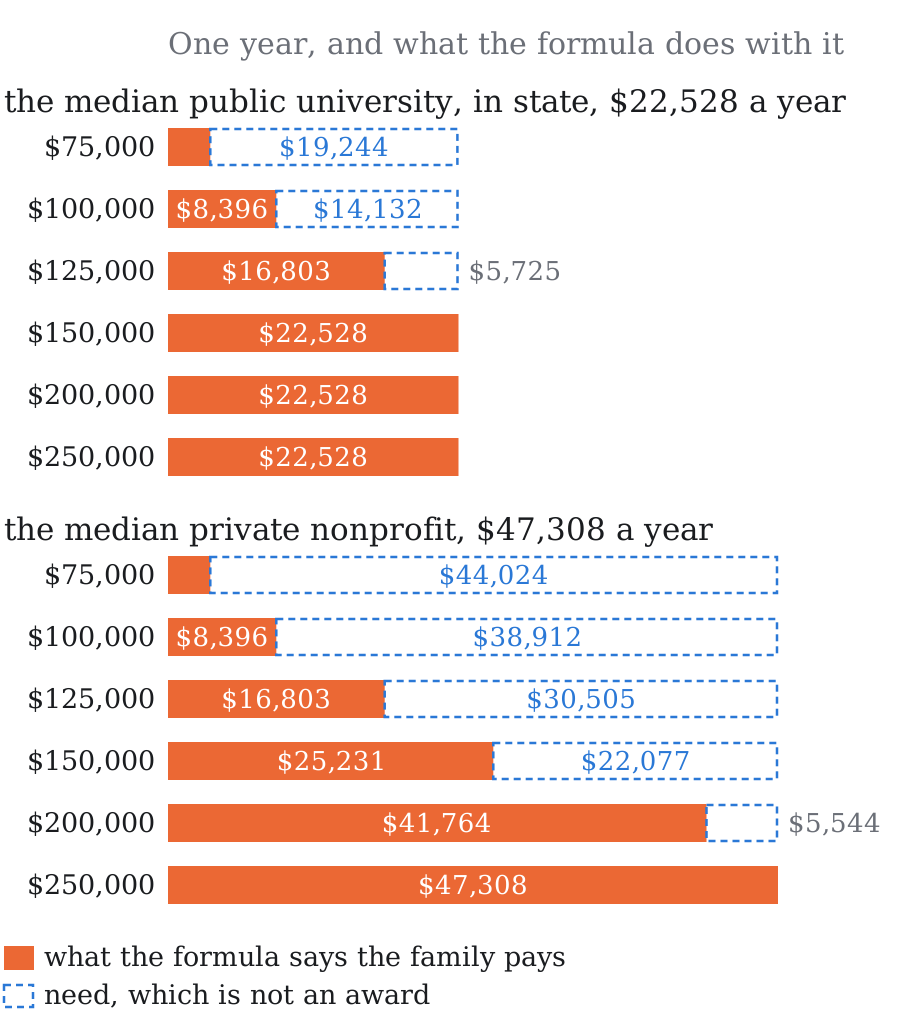
The hollow half of each bar is the number that matters here. At the median in-state public university, on a $75,000 income for a household of four, the index is about $3,300 and need is about $19,200. The estimator on this site runs the published federal worksheet line by line if you want your own figure rather than a median.
What the regulation actually says
Three sentences of 34 CFR 673.5 dictate the outcome.
The first says a scholarship counts. The regulation lists what a college must treat as estimated financial assistance, and the list is explicit: "Scholarships, including athletic scholarships". Tuition waivers and fellowships sit beside them in the same list.
The second sets the ceiling. A college may award campus-based aid, meaning Federal Work-Study, a Federal Supplemental Educational Opportunity Grant or a Perkins loan, only if that aid "combined with the other estimated financial assistance the student receives, does not exceed the student's financial need".
The third names what happens when money arrives after the package is built, which is the case the regulation is written for: "the overaward is the amount that exceeds need".
So the ceiling is need, not the bill. That distinction is the whole of it, and it cuts both ways.
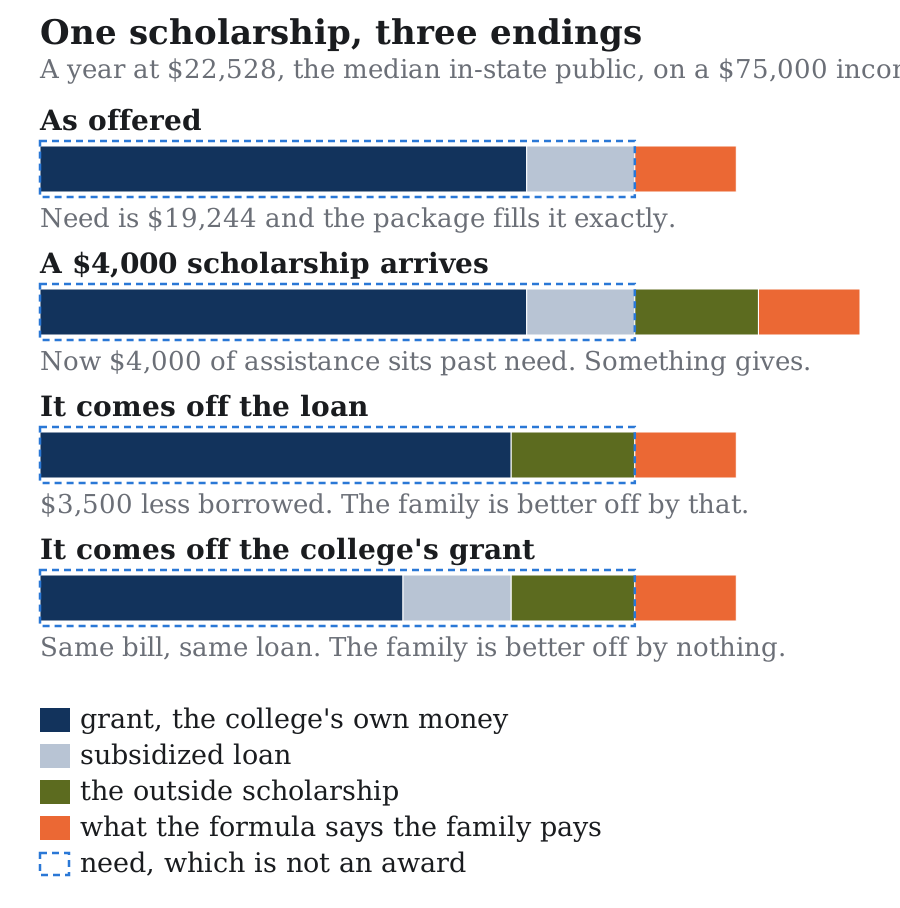
Where a package already fills need, an outside award pushes past the line and something is reduced. Where a package does not fill need, and most do not, the award lands in the gap and nothing is displaced at all. A family whose letter leaves them several thousand dollars short is in the second case, and for them a scholarship is worth its face.
Two more parts of the same regulation are worth knowing because they create room. Money "used to replace EFC", which the regulation says includes unsubsidized and PLUS loans, is not counted as estimated financial assistance, so it is not part of the sum that can overshoot. And assistance earmarked for a cost that the college has itself left out of the cost of attendance is excluded from both sides.
The part the rule does not decide
Nothing above dictates which line a college reduces. That decision belongs entirely to the college, and that single decision determines whether the family actually gains anything.
Reduce the subsidized loan first and the family borrows ~$3,500 less in that year. The bill is identical and the debt is smaller. That debt reduction is the entire value of the award. Reduce the college's own grant instead and the family has simply swapped one gift for another: the same bill, the same loan, and no net gain. Both outcomes are perfectly legal. Neither outcome is announced.
That college discretion is why a universal rule on displacement does not exist. Two colleges reading the same regulation and holding the same letter will do entirely different things with the money. A family comparing two letters in April has no way to tell from the letters themselves which path a college will take.
A handful of states have legislated, and the detail matters
Most have not. Connecticut's Office of Legislative Research described the default plainly when its own legislature acted: "there are no state laws that regulate how higher education institutions should manage scholarship displacement; the institutions themselves establish their own policies regarding how outside scholarships affect financial aid packages."
Connecticut changed that for itself. From July 1, 2026 an institution in the state may not reduce a student's aid because the student received a private or public scholarship, unless total aid from all sources meets or exceeds the cost of attendance, or a reduction is needed for a student athlete to satisfy an athletic association's rules. Connecticut separately requires every institution in the state to disclose its displacement policy in the initial aid offer. That disclosure duty is arguably the more useful half, and almost nowhere else has it.
Maryland is narrower than it first appears, in two ways worth reading carefully. Its restriction binds public senior higher education institutions, so a private college in Maryland is not covered. And its trigger is gift aid rather than all assistance: a reduction is allowed only where "a student's total gift aid from all sources exceeds the student's financial need", and the statute defines gift aid as "all financial aid that is not a loan or work-study program". Loans therefore do not push a Maryland student over the line, which makes the state test harder to trip than the federal one. A college may cut further if the scholarship provider approves, and may cut a student athlete's aid to meet association rules.
Other states have passed something. This guide names the two it has read in the statute, because the reporting on this topic is inconsistent enough that a list assembled from summaries would be wrong somewhere. Your own state is worth checking directly, and the rules move.
Call the financial aid office and ask
The federal half of this is public and is quoted above. The institutional half exists in one place, which is the financial aid office at each college on the list, and outside Connecticut nothing requires it to be written down anywhere a family can find it.
So call them. Every college publishes a financial aid office number, the call is free, and the question has a definite answer that the person on the phone deals with every spring.
Ask it narrowly, because a broad question gets a broad answer:
- If my student wins an outside scholarship, which line of the aid offer is reduced first, the loan and work-study or the college's own grant?
- Is there an amount we can win before anything is reduced at all?
- Does the answer change if the scholarship is paid directly to the college rather than to the student?
- Will you put that in writing, or point me to where it is published?
The last one matters most. A policy quoted on the phone in October is not a policy anyone can hold a college to in April, and an aid office that will send the answer by email has given a family something it can compare against a second college's answer.
Two moments are worth the call. Before applying for scholarships, because the answer decides how much the effort is worth. And again when an award actually arrives, because the amount and who it is paid to can both matter.
There is no wrong answer to collect here, and that is the point of asking rather than guessing. A college that reduces loans first is describing a policy worth real money to the student. A college that reduces its own grant first is describing one worth nothing. Both are legal and only one of them is worth chasing scholarships for.
One thing to hold onto while asking: an award that is displaced was not wasted in every sense, since a reduced subsidized loan is a smaller debt even when the bill is unchanged. What it does not do is the thing a family expects it to do, which is lower what they hand over in August.
Price the letter you actually have
None of this changes what the degree costs, and the cost is the larger question. Open the calculator in Detailed mode, which is the setting that builds the loan from your own figures instead of from the median debt this school's graduates happen to leave with. Three fields do the work, and every one of them is per year:
- Cost of Attendance: the figure on the letter rather than the tuition line, since it includes housing, food and books.
- Personal Contribution: what the family puts in from savings and income before any borrowing.
- Grants and Scholarships: everything in the package that is never repaid, which is where the answer from the aid office goes.
That last field is this whole guide in one input. If the college reduces the loan when an award lands, enter the college's grant plus the scholarship, and the loan the calculator builds falls by the award. If the college reduces its own grant instead, the two changes cancel, the figure you enter does not move, and neither does the loan. Entering a scholarship on top without knowing which of those happened understates the borrowing, and the borrowing is what the rest of the arithmetic rests on.
The per year label is doing work too. The field takes one figure and applies it to every year, so a one-time award goes in as its share of the years rather than at face: $4,000 won once against a four-year degree is $1,000 in that field, while a renewable $4,000 is $4,000. Between those two the difference is most of the award.