· 7 min read · worthmydegree.com
Where the federal money runs out
Every aid letter has two federal loans in it. One is in the student's name and one is in the parents' name, and both come with a ceiling that no school, no aid officer and no appeal can raise. Add the two ceilings together and you have the most the federal government will lend one family for one bachelor's degree. This guide puts that number beside the sticker price of every college that grants a bachelor's, and shows where the money runs out.
Every figure below comes from this site's own datasets and its own borrowing rules. Rounded figures carry a tilde; the ones without are legal limits and are exact.
The number
For a dependent student starting in 2026 or later, the student's own Direct loan is capped at $5,500 as a freshman, $6,500 as a sophomore and $7,500 in each of the last two years, which is $27,000 over four years. Parent PLUS is capped at $20,000 a year and $65,000 in total per student, and the total is the one that bites. Together:
$92,000 is the most a dependent student's family can borrow from the federal government for a four-year degree.
Nothing else is federally available to that family. An independent student can borrow more in their own name and has no Parent PLUS at all, so the line sits somewhere else for them. For the families this guide is about, it sits at $92,000.
One more fact before the pictures, because it surprised us. Of the 2,235 bachelor's-granting colleges in the dataset, there is not one where a single year of sticker price fits under the freshman's own $5,500. The student's loan on its own never covers a year anywhere. From the first semester, a family is either paying cash, getting aid, or borrowing in the parents' name.
What sticker price looks like against it
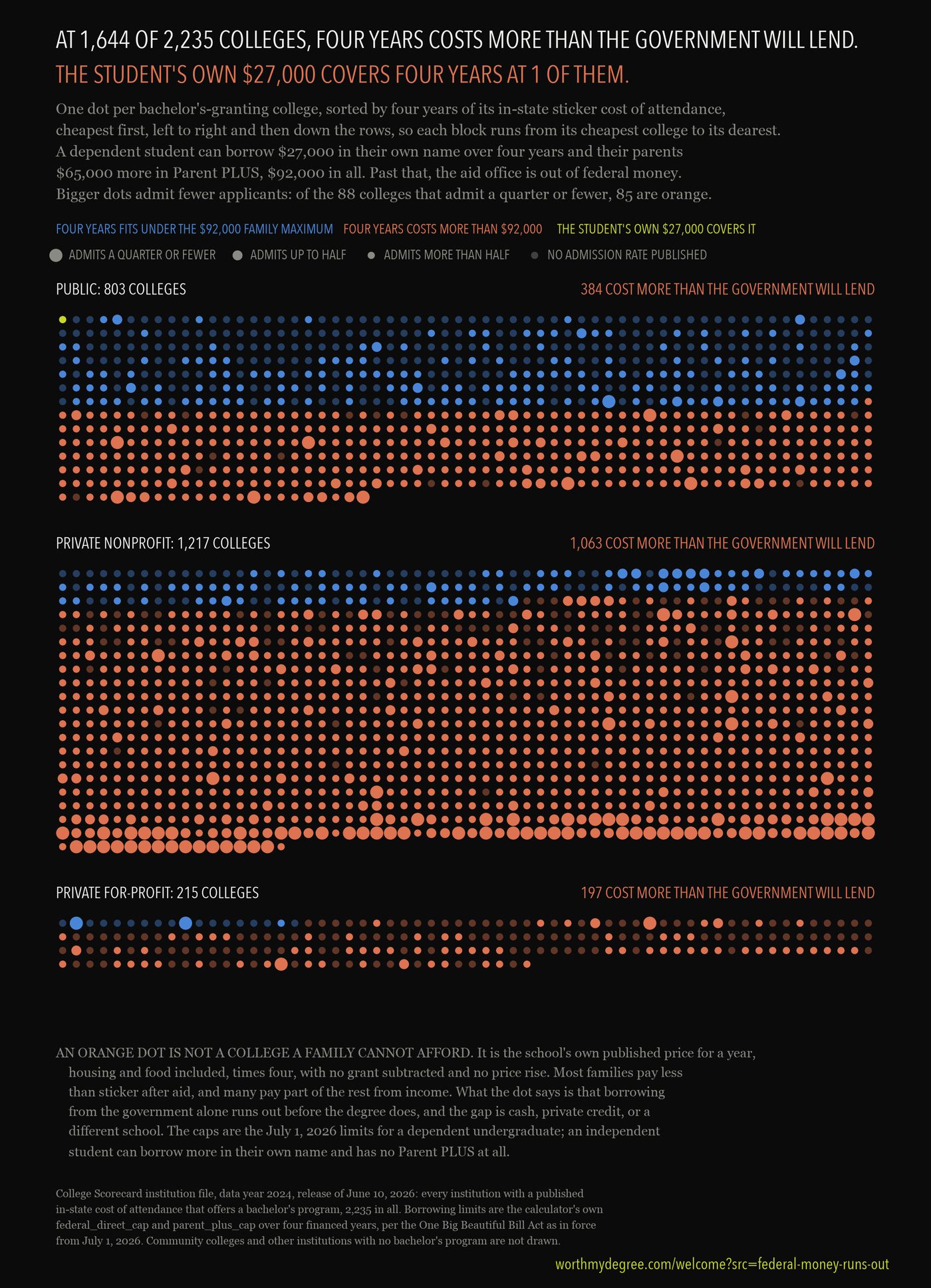
Take every college in the College Scorecard cost file that offers a bachelor's program and has a published in-state cost of attendance, and multiply that cost by four. The cost of attendance is the school's own figure for a year, housing and food included, at the in-state rate.
| Sector | Colleges | Four years costs more than $92,000 | Median four years, sticker |
|---|---|---|---|
| Public | 803 | 384, about half | ~$90,000 |
| Private nonprofit | 1,217 | 1,063, nearly nine in ten | ~$189,000 |
| Private for-profit | 215 | 197, more than nine in ten | ~$137,000 |
| All | 2,235 | 1,644, about three quarters |
Two things in that table are worth a second look. The median public university sits almost exactly on the line: four years there costs about $90,000 at sticker, against a $92,000 ceiling, so a typical public is affordable on federal money alone with about $2,000 to spare over four years, and half of them are not. And the private nonprofit median is more than twice the ceiling. At the typical private nonprofit, four years of sticker runs about $97,000 past what the government will lend, before any aid.
The dot sizes on the chart carry a third finding. Bigger dots are more selective colleges, and of the 88 colleges that admit a quarter or fewer of their applicants, 85 sit above the line. The famous schools are the exception that proves it: they are the most expensive at sticker and the most generous after it, so for them the sticker price is the least informative number on the page.
Where the line falls
The same colleges, at their own addresses:
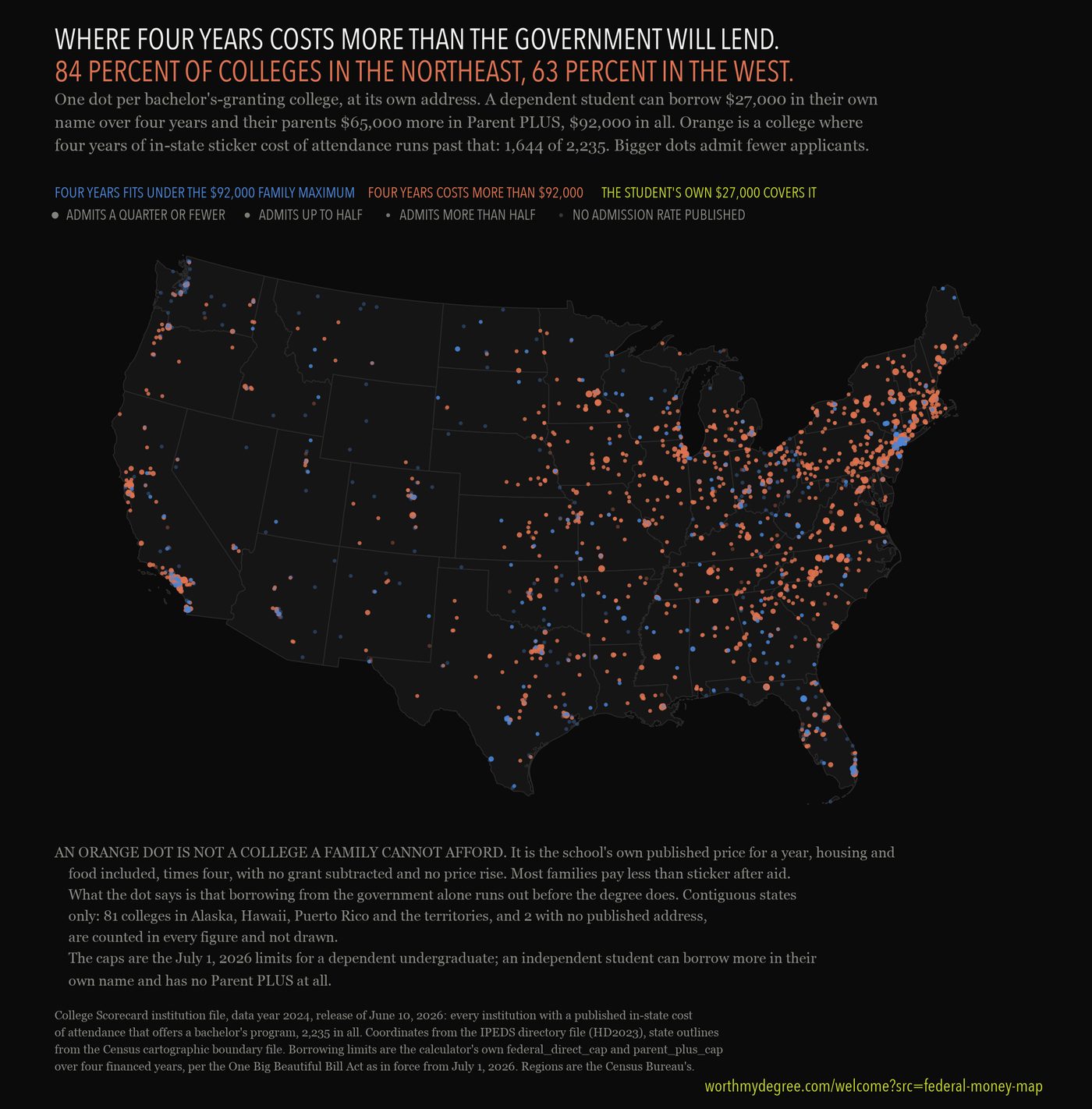
The blue is the public systems of the interior and the South. The orange is the two coasts and the Northeast corridor. By Census region:
| Region | Colleges where four years costs more than $92,000 |
|---|---|
| Northeast | ~84% |
| Midwest | ~78% |
| South | ~76% |
| West | ~63% |
The state your family lives in matters more than the region, because the in-state price only applies at home. Among states with at least ten public universities in the dataset, Wisconsin, Florida and Washington keep most of theirs under the line: 13 of 14 in Wisconsin, 36 of 41 in Florida, 34 of 42 in Washington. Virginia, Pennsylvania, Illinois, New Jersey and Maryland keep none. A family in Pennsylvania cannot pay four years of sticker at any public university in the state with federal loans alone, and a family in Florida can at nearly all of them.
What an orange dot is, and is not
An orange dot is not a college a family cannot afford. It is a sticker price, times four, with no grant subtracted and no price increase over the four years. Most families pay less than sticker after aid, and many pay part of the rest from income and savings. What the dot says is narrower and more useful: if this family borrowed from the government alone, the money would run out before the degree does.
How far before matters. Among the orange colleges, the median gap between four years of sticker and the $92,000 ceiling is about $70,000. At the orange publics it is about $17,000, which is a summer job and a smaller housing plan. At the orange private nonprofits it is about $110,000, which is a second mortgage or a private loan, and private money is worse money: a credit check, a co-signer, a market rate, and none of the income-driven repayment or forgiveness that federal loans carry.
So the question an orange dot asks is not whether the school is affordable. It is what fills the gap, and whether the family knows the answer in March, when there is still a choice to make, rather than in August.
What to do about your own school
Get your own number first. The gap is between sticker and the ceiling, but what a family actually pays is between the net price and the ceiling, and the net price depends on the Student Aid Index. This site's SAI tool runs the federal worksheet line by line and tells you what the CSS Profile schools will see differently. A family whose SAI is low may find an orange school covered mostly by grants. A family whose SAI passes the whole cost of attendance gets no need-based aid, and for them the map is exactly the map.
Plan the parent loan at $16,250 a year, not $20,000. The $65,000 total spread evenly over four years. Borrow at the annual cap for three years and the senior year has $5,000 left in it.
Price the route, not just the school. Two years at a community college first, lived at home and paid out of pocket, leave only two university years to set against the ceiling. That puts every one of the 384 orange public universities under it, and 423 of the 1,063 orange private nonprofits, without touching the credential. An in-state public in one of the states above is the other lever, and it is the one the map is drawn for.
Then ask whether the degree pays the gap back. Affordability decides what a year costs. It does not decide whether the degree is worth it. The calculator takes the school, the major and the loan that falls out of your number, applies these caps automatically, and measures the result against not going at all.
The federal ceiling is the one figure in college finance that does not move for anybody. Knowing where your school sits against it is the difference between choosing a gap and discovering one.